
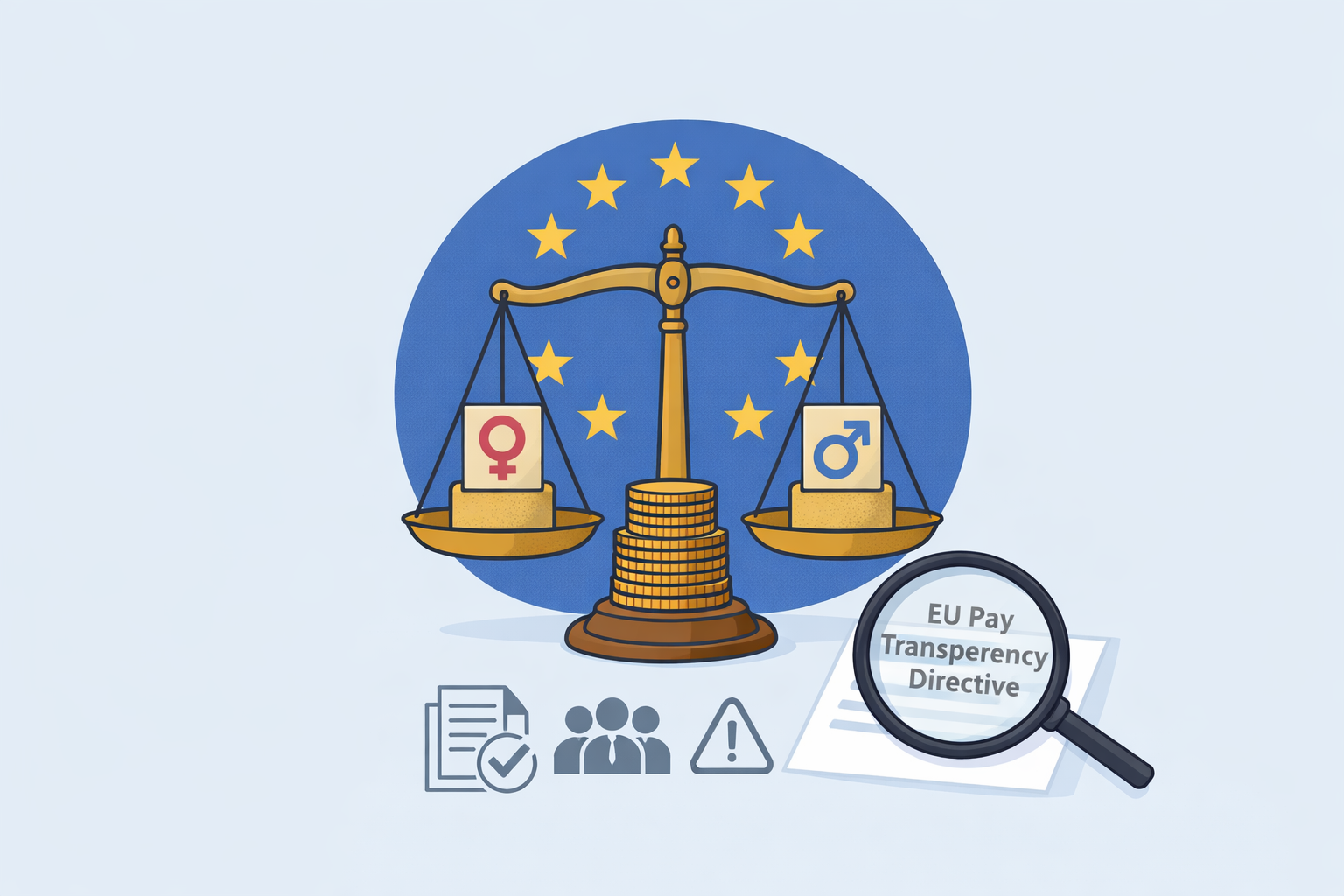
The European Union has taken a major step toward reducing the gender pay gap with the adoption of the EU Pay Transparency Directive (Directive (EU) 2023/970). The directive introduces new obligations for employers regarding salary transparency, reporting, and equal pay.
Member states must transpose the directive into national legislation by 7 June 2026, which means companies across the EU—including those operating in Bulgaria—will soon need to adapt their HR policies, compensation systems, and reporting practices.
Below is an overview of the key requirements and what employers should start preparing for.
Directive (EU) 2023/970 aims to strengthen the principle of equal pay for equal work or work of equal value between women and men.
The directive seeks to improve transparency around pay structures and ensure that employees and job applicants have access to clear information about how salaries are determined.
Increasing transparency in compensation systems
Helping employees identify and challenge pay discrimination
Strengthening enforcement mechanisms across EU member states
Introducing mandatory gender pay gap reporting
Although the principle of equal pay has existed in EU legislation for decades, the gender pay gap across the EU remains around 11–13%. A major reason for this disparity is the lack of transparency in how salaries are set and compared within organisations.
Even though the formal deadline is June 2026, companies should begin preparing well in advance. Implementation may require adjustments to HR policies, salary structures, internal reporting processes, and data systems.
The directive introduces new rules during the recruitment process.
Provide the starting salary or salary range in the job advertisement or before the interview process
Use gender-neutral language in job postings
Avoid asking candidates about their salary history
These measures aim to prevent existing pay inequalities from being carried over from one employer to another.
The directive strengthens employees’ rights to access information about pay structures.
Employees will have the right to request information about:
Their individual salary level
The average salary by gender for comparable positions
The criteria used to determine pay and career progression
Employers must ensure that these criteria are objective, transparent, and gender-neutral.
The directive introduces a structured methodology for comparing roles that may differ in function but provide comparable value to an organization.
The evaluation is based on four key criteria:
Skills – education, qualifications, and experience
Effort – physical or intellectual demands of the job
Responsibility – level of managerial or financial responsibility
Working conditions – working environment and potential risks
This means that different job positions may still be compared if the overall value of the work is considered similar.
Reporting obligations depend on the size of the company.
These reports must analyse gender pay differences across comparable job categories within the organisation.
If the analysis reveals a gender pay gap of 5% or more that cannot be justified by objective factors, employers must take corrective action.
This may include:
Conducting a joint pay assessment
Involving employee representatives
Analyzing the causes of the pay gap
Implementing corrective measures
The directive introduces stronger enforcement mechanisms and penalties.
Possible consequences for non-compliance include:
Financial penalties and fines
Payment of unpaid wage differences retroactively
Compensation for affected employees
Interest and additional financial damages
Restrictions on participation in public procurement procedures
A significant change is the shift in the burden of proof. In cases of suspected pay discrimination, the employer must demonstrate that no violation has occurred.
Preparation should begin before the directive becomes legally binding.
Recommended steps include:
Conducting a gender pay gap analysis
Reviewing job descriptions and job classifications
Establishing objective compensation criteria
Standardizing bonuses and promotion practices
Training HR teams and managers
Implementing systems for data collection and reporting
Early preparation will help organisations reduce legal risks and create more transparent and equitable compensation structures.
The EU Pay Transparency Directive represents one of the most significant developments in European labor legislation in recent years.
It pushes companies toward more transparent, structured, and data-driven compensation systems.
Organisations that begin preparing early will not only minimise compliance risks but also strengthen their reputation as fair, responsible, and transparent employers.